
Dysgraphia & Writing

Solutions for students who have difficulty writing.

Writing is a complex process that requires foundational motor, auditory, visual, and language processing skills. Writing challenges can be separated into two major competencies.

Writing Competency 1

The first competency concerns written composition and the ability to communicate one’s ideas coherently. The challenge of organizing and getting ideas down on paper primarily involves language skills, including organization, imagery, memory, encoding (spelling), and understanding of punctuation and grammar.

Writing Competency 2

Comprised of the visual-motor-spatial skills, which allow a student to produce legible written work, often called penmanship consistently.

When a student has difficulty with the print production of writing, it is called dysgraphia. For children with dysgraphia, writing can be a frustrating task, often marked by poor letter formation and handwriting. This, in turn, can make it cumbersome and slow to get their ideas onto the page.

Some learners struggle with one competency, while others struggle with both. Either way, Hands on Learning Solutions can support your child in improving their writing with a variety of approaches, customized to the individual learner’s needs.
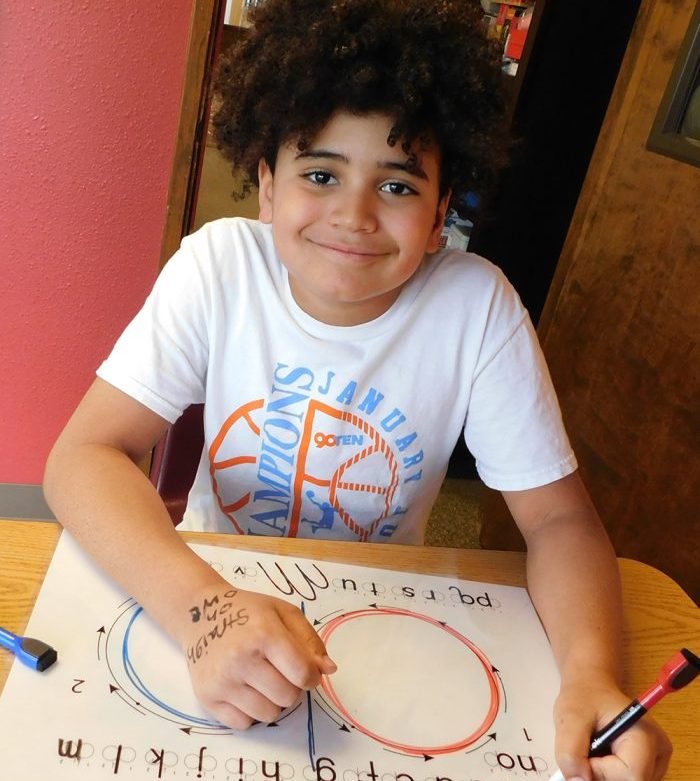
Dysgraphia vs Writing Disability. Both Involve Writing, but Show Up Differently.

Here are the common indications of each:

Dysgraphia

  • Avoidance of writing
  • Physical discomfort in the hand while writing
  • Maladaptive pencil grip
  • Extreme pressure when writing
  • Letters do not sit on the line
  • Letter heights are inconsistent
  • Spacing between letters & words is inconsistent
  • Poor letter formation

Written Composition

  • Avoidance of writing papers or journaling
  • Lack of fluency of thought in writing
  • Poor word choice
  • Sentences and paragraphs that do not connect logically
  • Lack of details
  • Repetitive words and sentences
  • May have a receptive and/or expressive language disorder

Note About Dysgraphia

Understanding the nuances of Dysgraphia is essential for providing effective remediation. It’s essential to remember that dysgraphia has nothing to do with intelligence – your child is just as capable as their peers. Still, they may require different tools and strategies to demonstrate their knowledge.

Dysgraphia Help

Designed to address all four factors that may be causing poor graphomotor skills, we look at the underlying weaknesses. We address active primitive reflexes that control pencil grip, directionality challenges, visual-motor-perceptual skills, and symbol imagery. To achieve accuracy in letter production, graphomotor skills will be actively taught, ensuring both the specialist and the student are engaged throughout. Feedback should be given immediately so that the student can adjust their performance.
 

Writing Help

When written composition is a challenge, we need to take a step back and address any underlying issues that may be causing difficulties with spelling, punctuation, and capitalization. Once these are addressed, we can help your child improve their ability to express themselves in writing.
 

After Years of Struggle, We Finally Found What Our Son Needed

One of the things I love most about HOLS is their mindset. They don’t see learning differences as obstacles; they see them as superpowers. That message has resonated deeply with both of us. Silas actually looks forward to his time at HOLS because he understands how it’s helping unlock his potential. He’s been met with love, care, and unwavering support, and the progress is more than we could have hoped for.
 

Julie S.
Parent of a Hands on Learning Solutions Student who struggled with writing.